
Diplomacy on Wheels: British PM Burnham’s Jaguar XJ Sentinel Meets French Leader Macron’s DS 7 Crossback Élysée in Paris

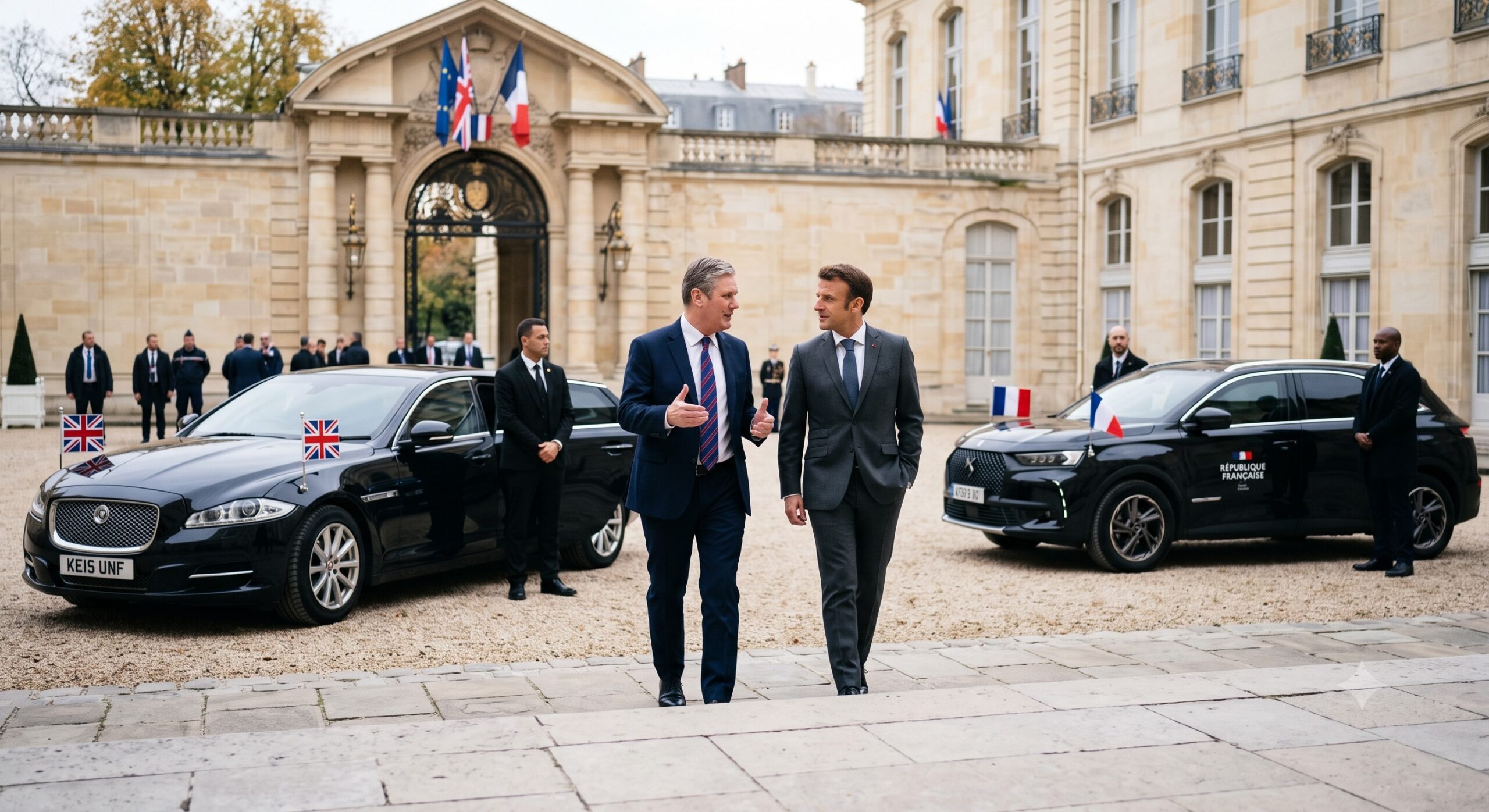
The photograph captures a striking diplomatic summit set against the historic grandeur of the Élysée Palace in Paris. As the British Prime Minister Burnham and French President Emmanuel Macron converse on the gravel courtyard, their respective state vehicles stand prominently behind them. This scene perfectly encapsulates high-stakes bilateral diplomacy blended with automotive prestige, highlighting how official state cars act as mobile extensions of national identity. Every detail, from the contrasting architectural tones to the flanking security details, frames this encounter as both a strategic meeting and a showcase of executive power. The cars themselves serve as quiet reflections of the leaders who ride in them and the sovereign industries they represent.
Flanking the British leader is the classic Jaguar XJ Sentinel, representing decades of heritage in Downing Street statecraft. Painted in traditional deep black and flying dual Union Jack pennants, the long-wheelbase Jaguar saloon delivers a silhouette defined by understated elegance and quiet authority. While Prime Minister Burnham has built a political persona around pragmatic leadership and modern regional advocacy, his choice of official transport relies on quintessential British luxury. The low-slung stance of the Jaguar prioritizes discretion over overt intimidation, projecting an aura of dignified, old-school statesmanship. Underneath its refined aluminum panels lies a heavy-duty protective cell engineered to withstand intense ballistic impacts and explosive blasts.
Technically, the Jaguar Sentinel is an engineering fortress disguised within an executive luxury saloon. Originally commissioned with bespoke B7-level ballistic protection, the vehicle features high-grade armored plating, multi-layered bulletproof polycarbonate glass, and run-flat tires mounted on alloy wheels. Beneath the sculpted bonnet sits a supercharged 5.0-liter V8 engine generating formidable torque to handle the sedan’s heavily reinforced weight. Inside, the cabin functions as a secure mobile office equipped with military-grade telecommunications and independent, self-contained air filtration systems. It provides Burnham with uninterrupted connectivity to Number 10 and Whitehall while ensuring complete isolation from any external threats.
On the other side stands President Emmanuel Macron’s state vehicle, an armored DS 7 Crossback Élysée bearing the iconic French tricolor and presidential emblems. Crafted by DS Automobiles, the high-end luxury marque of the PSA/Stellantis group, this presidential transport embodies modern French savoir-faire. Macron has consistently favored domestic automotive innovation since his inauguration, championing contemporary crossover utility over traditional executive limousines. The deep Ink Blue DS 7 exudes high-tech chic, featuring the brand’s jewel-like LED headlights and an upright, commanding radiator grille. Its modern SUV profile aligns with Macron’s forward-looking administrative brand, emphasizing modern engineering, sustainable hybrid capability, and distinctly Parisian flair.
The engineering behind Macron’s DS 7 Crossback Élysée is heavily customized to meet stringent presidential specifications. The chassis has been specially extended by twenty centimeters behind the B-pillar to maximize rear legroom, transforming the back cabin into an executive boardroom on wheels. Under the hood, the SUV utilizes DS’s advanced E-TENSE plug-in hybrid system paired with intelligent all-wheel drive, generating around 300 horsepower. This hybrid powertrain allows Macron to navigate urban centers in near-silent electric mode while maintaining instantaneous acceleration when required. Inside, bespoke Basalt Black leather watchstrap upholstery and integrated document consoles blend artisan craft with state-of-the-art encrypted communications.
Comparing these two machines reveals fundamentally different philosophies in state vehicle procurement. The British prime ministerial fleet has historically gravitated toward the low, sweeping, three-box proportions of luxury saloons like Jaguar, Daimler, and Rover. This conservative tradition highlights British executive restraint, prioritizing timeless formality and an aerodynamic profile over aggressive street dominance. Conversely, the modern French presidency has continually embraced modern crossovers and avant-garde fastback designs from PSA and Renault. Macron’s DS 7 sits taller, offering effortless ingress, greater panoramic visibility during parades, and a more pronounced presence in international motorcades. Where London favors classical grand-tourer luxury, Paris chooses contemporary utility elevated by artisanal interior design.
Beyond aesthetics, the presence of these cars on foreign soil is a vital exercise in soft power and industrial pride. State cars are deliberate diplomatic ambassadors, showcasing the sovereign manufacturing capabilities of their respective nations to the world. When Burnham steps out of a British-engineered Jaguar in the center of Paris, he reinforces Britain’s legacy of high-performance automotive engineering. Similarly, Macron’s reliance on DS Automobiles reinforces France’s commitment to automotive luxury and environmental transition through plug-in electrification. For high-level summits between cross-Channel partners, arriving in domestically branded iron is a silent yet unequivocal statement of economic independence, security self-reliance, and patriotic leadership.
Ultimately, this snapshot captures far more than two politicians walking side by side; it records the physical instruments of statecraft in sharp relief. The armored Jaguar XJ Sentinel and the custom DS 7 Crossback Élysée embody two contrasting visions of executive transit that mirror their drivers’ public identities. Burnham’s vehicle offers classical power and fortified discretion, while Macron’s crossover radiates high-tech French sophistication and progressive utility. As geopolitical discussions unfold inside the palace halls, these rolling fortresses remain poised outside, ready to protect their leaders at a moment’s notice. They serve as enduring testaments to how national tradition, high technology, and defense engineering intersect on the grand stage of world diplomacy.