
Shielded Power: Benjamin Netanyahu and His Armored Mercedes-Benz S-Guard

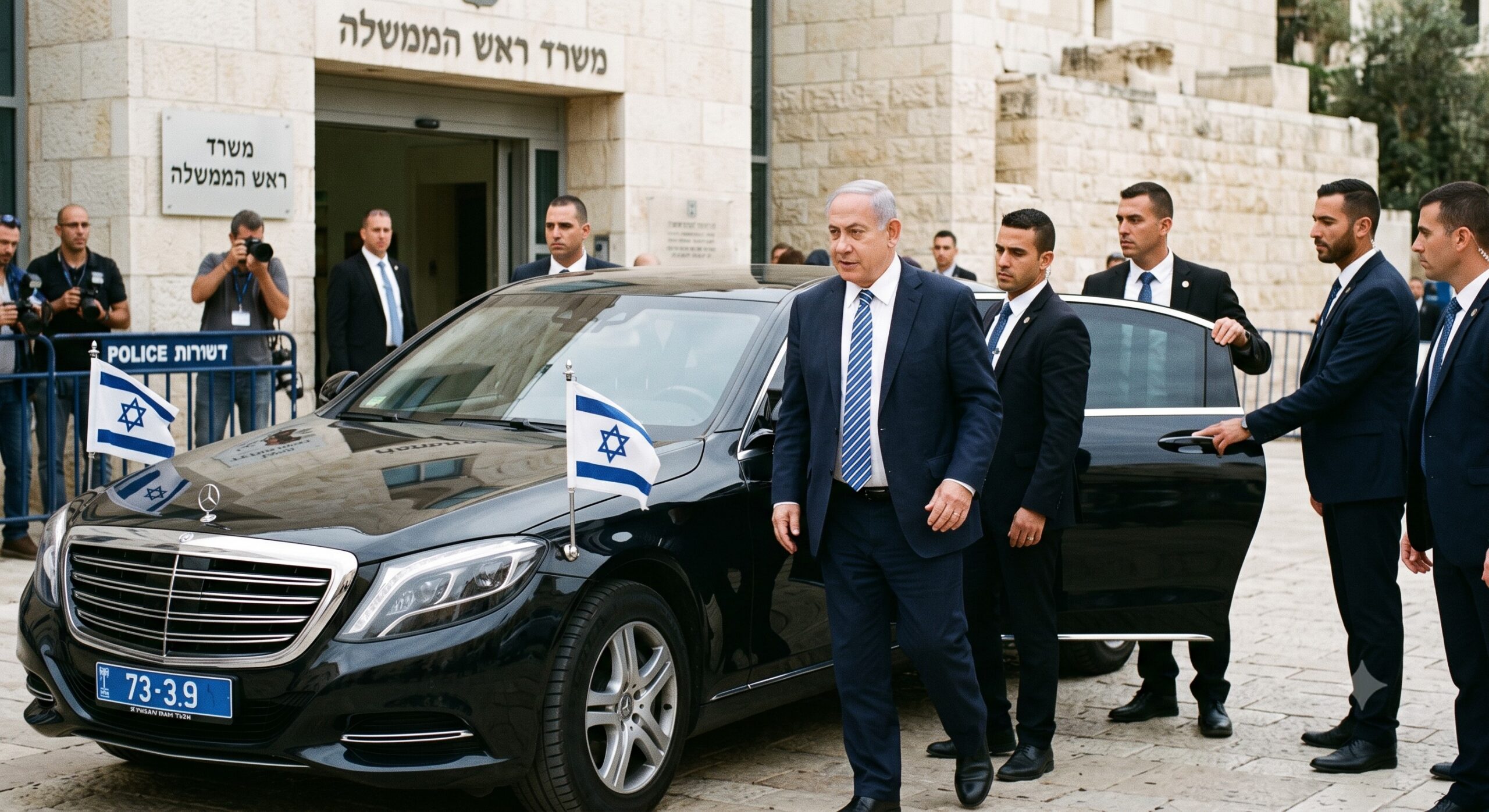
The photograph captures a striking, cinematic moment as Israeli Prime Minister Benjamin Netanyahu steps out of his official state limousine outside a government building. Dressed in his signature sharp navy suit and blue-striped tie, Netanyahu projects the image of a seasoned, confident statesman who has spent decades navigating intense geopolitical friction. Encircling him is a tightly knit cordon of Israeli Shin Bet security agents, identifiable by their watchful eyes, discreet communication earpieces, and dark corporate attire. Prominently displayed on the front fender is the national flag of Israel, mounted alongside official ministerial plates that unmistakably signal executive authority. Behind this authoritative arrival stands the true centerpiece of the image: a meticulously engineered luxury fortress on wheels. It is a visual testament to the delicate balance between high-level diplomatic prestige and the unyielding necessity of presidential survival.
The vehicle shown in this evocative scene is a heavily modified Mercedes-Benz S-Class, universally regarded as the gold standard for global executive motoring. The Mercedes-Benz S-Guard lineage, which this car represents, is revered across diplomatic circles for blending peerless German engineering with discreet, almost imperceptible protective capabilities. Unlike overt military troop carriers, the S-Guard retains the sleek curves, chrome horizontal grille, and luminous LED headlights of a showroom luxury flagship. Underneath its gleaming obsidian finish, however, lies an integrated shell of specialized ballistic steel, aramid fabrics, and multi-layered polycarbonate glass designed to withstand severe direct impacts. Netanyahu has often been chauffeured in Mercedes-Benz and Audi flagships, leaning toward German engineering that provides an understated yet commanding presence. This aesthetic mirrors his political persona: polished and aristocratic on the surface, but shielded by hardened resilience beneath.
While the exterior silhouette resembles a conventional luxury sedan, the engineering beneath the surface transforms it into a rolling, hermetically sealed sanctuary. State-level protection requires vehicles in Israel to meet rigorous VR9 or VR10 ballistic standards, safeguarding occupants against military-grade rifle rounds and armor-piercing ammunition. The vehicle’s floor pan is heavily reinforced with shaped blast-deflection plating to survive coordinated landmine explosions and improvised explosive devices (IEDs) detonated beneath the chassis. The ultra-thick multi-pane windows are lined with an internal splinter-shield polycarbonate layer to prevent shattering into the cabin. Furthermore, the tires are reinforced with Michelin PAX run-flat systems, allowing the heavy sedan to escape kill zones at high speeds even with zero air pressure. For an Israeli head of state operating amidst persistent regional volatility, such comprehensive structural armor is not an extravagant indulgence, but a daily operational prerequisite.
Inside the passenger cell, the cabin functions as an ultra-secure, mobile Command and Control center that enables uninterrupted executive decision-making. Israeli prime ministers, and Netanyahu in particular, maintain an exhausting schedule requiring secure encrypted satellite communications, direct military hotlines, and continuous defense briefing access. The rear cabin is equipped with independent filtration and emergency oxygen tanks that can completely isolate the interior from tear gas, biological agents, or chemical toxins. Beyond raw survival mechanisms, the cabin caters to refined personal comforts, featuring orthopedic massage seating, premium leather upholstery, climate zoning, and bespoke refrigerated compartments. Netanyahu is well known for his taste in fine cigars and premium amenities, and official state limousines are occasionally tailored to discreetly accommodate such executive preferences. Every inch of the interior is engineered to ensure the leader remains rested, connected, and fully operational during cross-country transits.
To propel a vehicle whose curb weight can exceed four tons due to comprehensive plating, immense mechanical firepower is an absolute requirement. This armored flagship is typically motivated by a robust twin-turbocharged V8 or a mammoth V12 powerplant capable of churning out north of 500 horsepower. Paired with adaptive heavy-duty air suspension and upgraded high-performance braking systems, the vehicle accelerates with deceptive agility despite its immense mass. Specially tuned transmission and drivetrain components ensure that evasive maneuvers can be executed instantly should the convoy face an ambush or obstruction. The steering geometry and electronic stability controls are uniquely calibrated by factory engineers to counterbalance the elevated center of gravity and prevent rollover during high-speed evasion. In the world of high-risk dignitary transport, raw horsepower translates directly into survival leeway, giving the elite driver the capacity to punch through roadblocks.
Israel’s Prime Ministerial motorcade history showcases an intriguing evolution of vehicular preferences shaped by politics, technology, and security realities. Historically, Israeli leaders favored utilitarian American sedans such as armored Cadillacs, Buicks, and Chevrolets, largely reflecting strong diplomatic and financial ties with Washington. In recent decades, however, procurement transitioned steadily toward the German automotive triumvirate, specifically Audi and Mercedes-Benz, prized for their cutting-edge ballistic integration. Netanyahu himself has made extensive use of the Audi A8 L Security—powered by a massive W12 engine—as well as top-tier Mercedes-Benz S-Guard models. These choices reflect a calculated organizational preference for vehicles that merge into civilian traffic rather than shouting their presence like the American presidential Beast. The transition to high-end German limousines highlights a modern leadership style that values high-tech sophistication, quiet discretion, and dynamic handling.
The formidable automobile does not operate in isolation; it is the beating heart of a complex, synchronized protective detail run by the Shin Bet’s VIP Protection Unit. When Netanyahu travels, the primary limousine is surrounded by a convoy of support vehicles, including armored Toyota Land Cruisers, tactical intervention teams, and jammer-equipped SUVs. These accompanying vehicles are fitted with multi-directional radio jamming antennas designed to disrupt remote-controlled bomb triggers and cellular signals along the route. Israeli security protocols require advance scouting teams, airborne surveillance, and rapid medical evacuation assets to shadow the prime minister’s journey. Every entry and exit, as captured in this photo, follows a strict choreography where bodyguards form overlapping physical shields around the politician. Even the simple act of opening the heavy, counterbalanced armored door is timed to minimize exposure to potential sniper sightlines.
Ultimately, this image encapsulates the intense operational reality that defines the life of one of modern history’s most guarded political figures. Standing beside his flagship limousine, Benjamin Netanyahu embodies the profound intersection of executive power, sophisticated engineering, and high-stakes survival. The black sedan in the frame is neither a mere status symbol nor an ordinary conveyance, but an indispensable instrument of national governance. It reflects the harsh security calculus of the Middle East, where world leaders must conduct statecraft behind bulletproof glass and titanium alloys. Through its flawless metallic shine, subtle national flag, and hidden mechanical armor, the vehicle mirrors the very nature of Netanyahu’s enduring political career: formidable, meticulously guarded, and perpetually prepared for the unexpected.