
Diplomacy in the Shadow of Steel: When Putin’s Aurus Senat Meets Zelensky’s Mercedes-Benz S-Guard

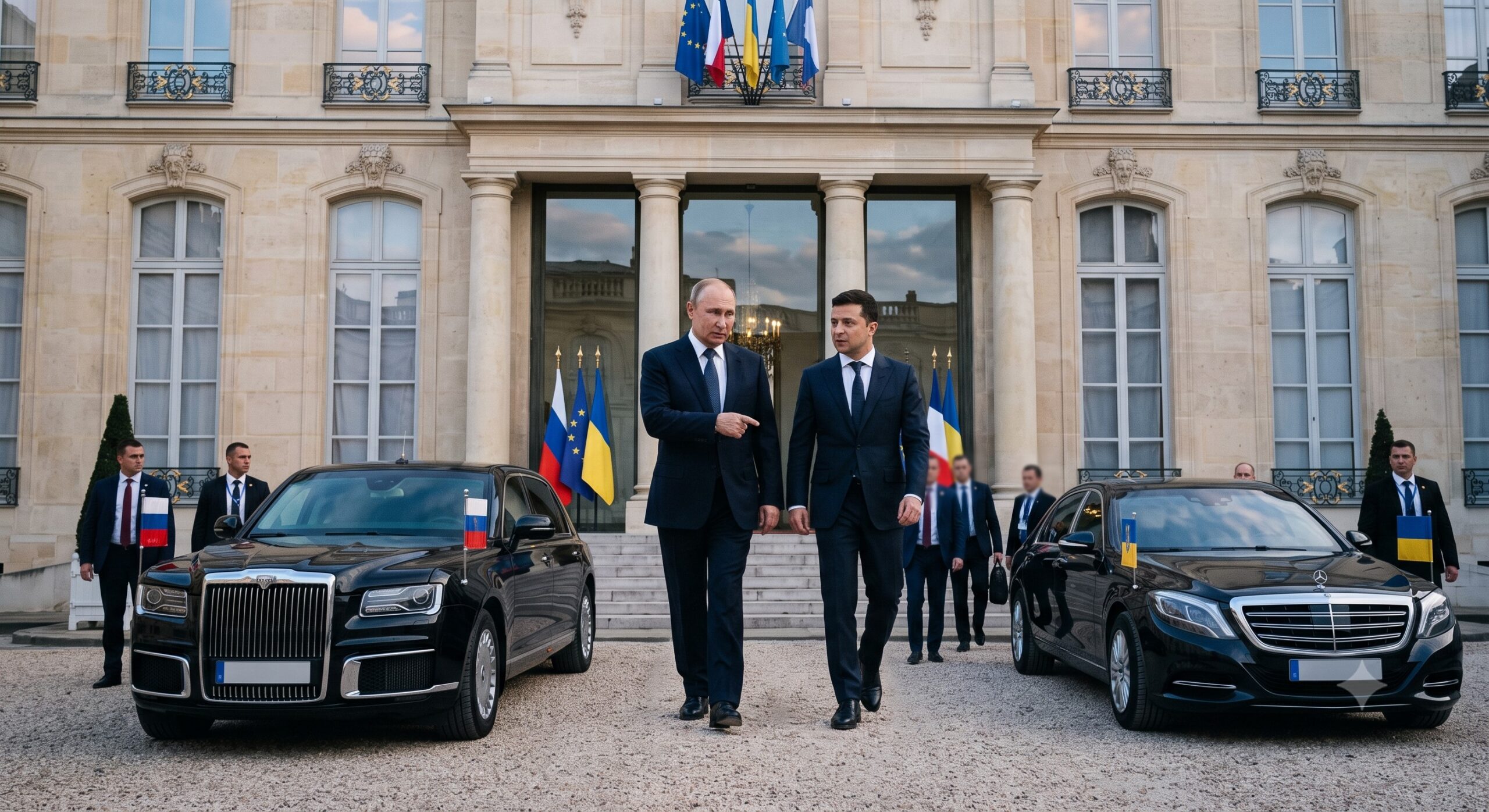
The striking image of Russian President Vladimir Putin and Ukrainian President Volodymyr Zelensky walking side by side evokes immediate global curiosity and intense geopolitical discussion. A direct bilateral meeting between these two leaders has long been viewed by the international community as one of the most critical diplomatic breakthroughs needed to de-escalate the ongoing conflict in Eastern Europe. Although formal negotiations have repeatedly stalled due to fundamentally incompatible demands regarding territorial sovereignty and future security guarantees, the prospect of direct dialogue remains an enduring aspiration among world diplomats. In this visual depiction, set against the grand backdrop of a neoclassical European palace adorned with national and EU flags, the atmosphere appears solemn yet remarkably communicative. Moments like this remind observers that regardless of how intractable wartime diplomacy may seem on paper, face-to-face engagements between state leaders hold unique psychological weight in transforming geopolitical reality.
Behind the two statesmen stand their official motorcade vehicles, which serve as far more than mere modes of transportation; they are moving fortresses and symbolic extensions of national power. In modern statecraft, a leader’s motorcade vehicle reflects country-specific industrial ambition, tactical protection philosophy, and deeply cultivated political branding. Every inch of steel, ballistic glass, and drivetrain technology is tailored to meet the highest security standards known to defense engineering. When presidents arrive at summit venues, the sight of their bespoke state limousines sets the tone for prestige and sovereign resilience. In this frame, the stark visual comparison between the imposing, domestic Russian limousine on the left and the sleek, precision-crafted German luxury sedan on the right captures the contrasting mechanical cultures of both administrations. A closer inspection of each flagship car unveils fascinating details about automotive engineering, armored performance, and presidential preference.
Positioned on the left is the Aurus Senat, the crown jewel of Russia’s indigenous luxury automotive project and Vladimir Putin’s signature state limousine. Developed by the Central Scientific Research Automobile and Automotive Engines Institute (NAMI) under the high-priority “Kortezh” program, the Senat represents Russia’s concerted drive toward self-reliant luxury and technological prestige. Designed deliberately with an authoritative upright waterfall grille reminiscent of vintage Soviet ZIS limousines and classic British luxury models, the Senat projects unyielding authority. Putin personally championed the vehicle’s development to replace the imported Mercedes-Benz Pullman limousines previously utilized by Kremlin heads of state. Underneath its muscular exterior lies a formidable 4.4-liter twin-turbocharged hybrid V8 engine capable of delivering nearly 600 horsepower, mated to a 9-speed automatic gearbox. This bespoke powertrain was engineered specifically to ensure that the vehicle’s immense armored tonnage does not compromise rapid acceleration and tactical maneuverability during an emergency evacuation.
The defensive architecture of the Aurus Senat transforms it into what defense analysts commonly describe as an impenetrable rolling fortress. The Presidential L700 edition incorporates VR10 ballistic and blast protection standards, capable of withstanding direct fire from armor-piercing sniper rounds and military-grade high-explosive detonations beneath its chassis. The vehicle is equipped with multi-layered reinforced run-flat tires mounted on heavy-duty wheels, allowing the limousine to travel at sustained highway speeds even after total pressure loss. Inside, the Senat features an autonomous life-support oxygen system designed to seal the passenger cabin entirely against chemical, radiological, and biological attacks. Advanced electronic countermeasures, encrypted communications hubs, and heavy emergency armor plating round out an astonishing vehicle that measures well over six meters in length. Through this menacing yet opulent machine, Putin deliberately broadcasts Russian sovereignty, manufacturing revival, and uncompromising national resilience to the outside world.
Conversely, on the right stands the quintessential choice of European state leadership: the armored Mercedes-Benz S-Class (specifically configured as an S-Guard / Mercedes-Maybach executive sedan) utilized by Volodymyr Zelensky’s diplomatic motorcade. Ukrainian official fleets have long relied on premium German automotive engineering, favoring Mercedes-Benz for its benchmark-setting balance of safety, discretion, and peerless mechanical reliability. Unlike the hulking, militaristic stance of the Aurus Senat, the S-Class presents an understated, aerodynamic silhouette that conceals its armored capabilities beneath clean, elegant body lines. Zelensky’s public persona often emphasizes practicality, modernization, and close integration with Western institutions, and his preference for a refined German flagship sedan aligns seamlessly with this approach. In high-stakes transit, the Mercedes sedan projects modern executive dignity while retaining the high agility required to navigate narrow European city streets without drawing disproportionate spectacle.
Beneath the understated exterior of the Mercedes-Benz S-Guard lies cutting-edge protective engineering tailored specifically for VIP and state defense. Built directly on a reinforced factory chassis rather than modified retroactively, the S-Guard incorporates integrated aramid and specialized high-strength steel armor into its body shell. The sedan utilizes multi-layered ballistic glass with polycarbonate splinter protection on the inner side, defending occupants against sustained small-arms fire and fragmentation grenades. Powered by either a robust 4.0-liter biturbo V8 or a legendary 6.0-liter twin-turbo V12 powerplant, the Mercedes delivers relentless torque smoothly to its intelligent all-wheel-drive system. The interior remains a haven of executive luxury, boasting active noise cancellation, climate-controlled massage seating, and state-of-the-art MBUX digital interfaces. It represents the gold standard of executive transport: maximum survivability wrapped in an aura of refined, effortless prestige.
The juxtaposition of these two distinctive vehicles reflects the contrasting geopolitical aesthetics and industrial philosophies of their respective leaders. Putin’s Aurus Senat is loud in its symbolism, explicitly designed to demonstrate that the Russian federation can manufacture its own super-luxury armored transport free from Western dependencies. It is an intentional monument to nationalist engineering and raw state sovereignty, mirroring Putin’s enduring rhetoric of civilizational independence. In contrast, Zelensky’s Mercedes-Benz showcases a forward-looking European sensibility that values proven global engineering, agility, and modern refinement over overt domestic manufacturing displays. While one car prioritizes an almost fortress-like visual intimidation, the other focuses on stealthy protective integration and effortless urban agility. These two vehicles on the gravel courtyard mirror the ideological divide between Moscow’s insular traditionalism and Kyiv’s integration with the broader Euro-Atlantic sphere.
Ultimately, whether such an extraordinary diplomatic meeting materializes in real life depends on complex military, political, and historical factors far beyond automotive protocol. Yet, visual depictions and symbolic encounters such as this hold immense power, providing a thought-provoking glimpse into what the mechanics of peace and high-level negotiation might eventually look like. The presence of their flagship presidential vehicles serves as a reminder that behind every historic peace conference lies intricate security apparatuses and carefully staged political symbols. Both leaders carry the profound weight of their respective nations, flanked by vehicles engineered to protect them through the most dangerous geopolitical climates. As the global public and military observers continue to track developments on the diplomatic front, this scene captures a powerful vision where diplomatic discourse and executive statecraft converge upon the world stage.