
Power on the Tarmac: Trump and Xi Jinping Meet Beside the Armored Cadillac Beast and Hongqi Limo

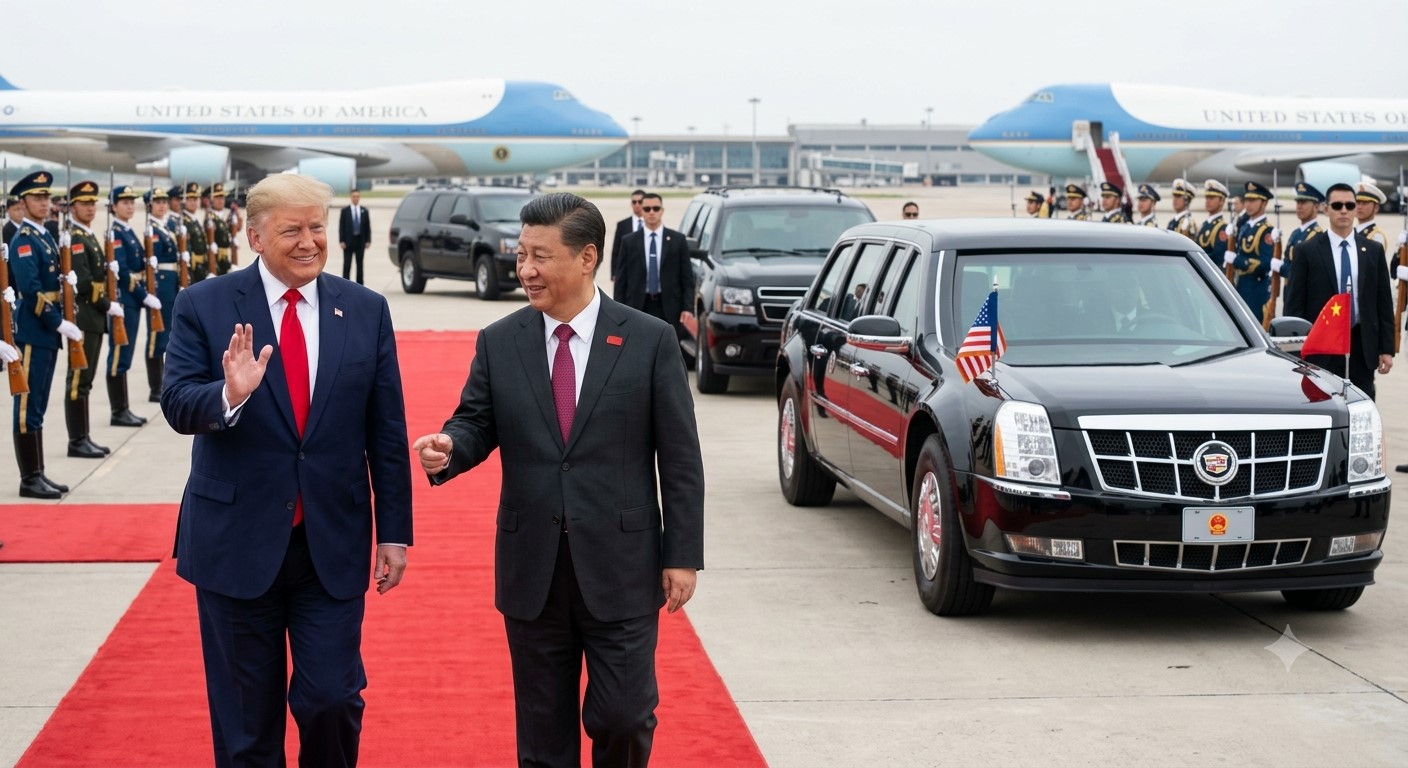
The striking image of Donald Trump and Xi Jinping walking side by side on a formal red carpet at the airport runway captures a defining moment in contemporary global diplomacy. Flanked by massive presidential aircraft in the background, a sharply disciplined military honor guard, and vigilant security personnel, the atmosphere is charged with the unmistakable gravity of a high-stakes summit. Beyond the immediate diplomatic choreography, one of the most compelling focal points in this frame is the presidential state vehicle positioned closely alongside the world leaders. In statecraft, an official motorcade is far more than a practical mode of transport; it serves as a mobile fortress engineered to guarantee the absolute security of the commander-in-chief. It also functions as a rolling ambassador of national prestige, industrial prowess, and sovereign authority on the international stage. Every detail, from the gleaming armored bodywork to the diplomatic flags mounted on the fenders, reflects the immense weight of the relationship between these two geopolitical titans.
Central to American executive transport is the legendary presidential limousine commonly known as “The Beast,” built on a bespoke Cadillac platform by General Motors. While sporting the refined styling cues, signature front grille, and iconic emblem of a Cadillac luxury sedan, underneath the surface it is essentially a heavy-duty commercial truck chassis engineered like a military tank. The vehicle features eight-inch-thick armored plating constructed from a combination of steel, aluminum, titanium, and ceramic layers designed to withstand direct hits from armor-piercing bullets, landmines, and rocket-propelled grenades. Its reinforced multi-layer windows measure five inches thick and are permanently sealed against chemical and biological attacks, supported by an independent internal oxygen supply system. Trump has often expressed immense fascination with the immense engineering, sheer scale, and imposing physical bulk of “The Beast” during his public appearances.
Donald Trump’s personal taste in automobiles has always leaned heavily toward flamboyant luxury, bold statement pieces, and extraordinary engineering that mirrors his larger-than-life persona. Long before entering public office, his private garage featured an array of ultra-exclusive machinery, ranging from bespoke Rolls-Royce Phantoms and vintage Silver Clouds to high-performance exotics like the Lamborghini Diablo and the Mercedes-Benz SLR McLaren. He naturally gravitates toward machines that project power, commanding road presence, and unapologetic prestige, appreciating vehicles with muscular proportions and distinctive visual flair. The heavily armored Cadillac presidential limousine fits this personal aesthetic perfectly, presenting a monumental silhouette that effortlessly commands attention wherever it travels. For Trump, an automobile is not merely a means of transit, but an unmistakable extension of strength, stature, and undeniable personal influence.
In stark contrast, China’s premier diplomatic automotive identity is embodied by Hongqi (meaning “Red Flag”), the historic luxury marque manufactured by state-owned FAW Group. Established during the era of Chairman Mao Zedong, Hongqi has served as the revered official chariot of the Chinese Communist Party’s highest leadership for generations. During modern diplomatic summits and major state reviews, Xi Jinping is invariably seen using specially crafted armored flagships, such as the prominent Hongqi N701 and the bespoke L5 limousine series. These vehicles incorporate classic, imposing Chinese architectural proportions alongside cutting-edge modern ballistic materials and proprietary secure digital infrastructure. Through the prominent deployment of Hongqi vehicles at global events, China deliberately broadcasts its technological self-reliance, domestic manufacturing maturity, and rich heritage directly to the world.
Xi Jinping’s approach to presidential transport is deeply rooted in promoting patriotic pride and showcasing China’s rapid transformation into an independent automotive juggernaut. Unlike many world leaders who utilize customized European luxury sedans, Xi has consistently insisted on traveling exclusively in domestic Hongqi vehicles during both domestic events and official state visits abroad. His preference highlights the strategic objectives of the “Made in China” initiative, proving that domestic manufacturing can compete directly with the world’s finest automotive engineering. The Hongqi limousine features an upright waterfall chrome grille, extended wheelbase proportions, and classical design accents that evoke an aura of calm, monolithic dignity and imperial tradition. This restrained yet imposing aesthetic stands as an intriguing philosophical counterpart to the raw, armored muscularity championed by American presidential vehicles.
The dynamic between the two leaders depicted in this photograph is heightened by the presence of the diplomatic limousine adorned with both national flags. Trump’s expressive posture and animated hand gestures convey his characteristic communicative energy, while Xi’s focused stride and subtle, measured smile reflect his deliberate and composed diplomatic demeanor. Behind them, the support fleet of heavy-duty black SUVs, trailing security officers, and the immense profile of Air Force One emphasize the massive logistical architecture required for such an encounter. The limousine parked adjacent to the red carpet effectively anchors the composition, symbolizing how state machinery continuously shadows personal diplomacy. Each diplomatic detail visible on the tarmac serves as a calibrated signal of sovereignty, security readiness, and mutual strategic respect between Washington and Beijing.
From a purely technological standpoint, both nations’ official state limousines represent the absolute pinnacle of covert engineering and protective innovation. Both vehicles are equipped with Kevlar-reinforced run-flat tires mounted on solid steel rims, ensuring that the vehicles can maintain highway escape speeds even if the tires are shredded by explosives or gunfire. The cabins feature fully isolated environmental controls capable of completely neutralizing airborne toxins, supported by secure satellite communications nodes that guarantee uninterrupted executive command anywhere on Earth. Advanced fire-suppression systems, blast-resistant floor pans, and heavily shielded electronic components protect against electromagnetic pulse (EMP) disruptions and catastrophic impacts. While externally dressed to resemble refined executive limousines, their structural composition and survivability standards align them much closer to elite armored fighting vehicles.
Ultimately, this vivid visual encounter between Donald Trump and Xi Jinping offers a fascinating lens into how leadership philosophy, industrial pride, and design language converge on the tarmac. The juxtaposition of America’s Cadillac fortress and China’s Hongqi imperial carriage illustrates two distinct visions of global influence and technological mastery. A state arrival is carefully choreographed down to the millimeter, and the presence of these bespoke machines reminds observers that modern diplomacy is supported by tremendous industrial capability. As both leaders walk the red carpet before entering bilateral negotiations, their official vehicles stand as silent yet profound declarations of their nations’ respective power, resilience, and geopolitical ambition. Understanding the engineering and symbolic depth of these rolling icons enriches our appreciation of the complex diplomatic ballet unfolding before the cameras.