
Power, Prestige, and Armor: Russian President Vladimir Putin’s Aurus Senat Meets Chinese President Xi Jinping’s Hongqi N701 in Bishkek

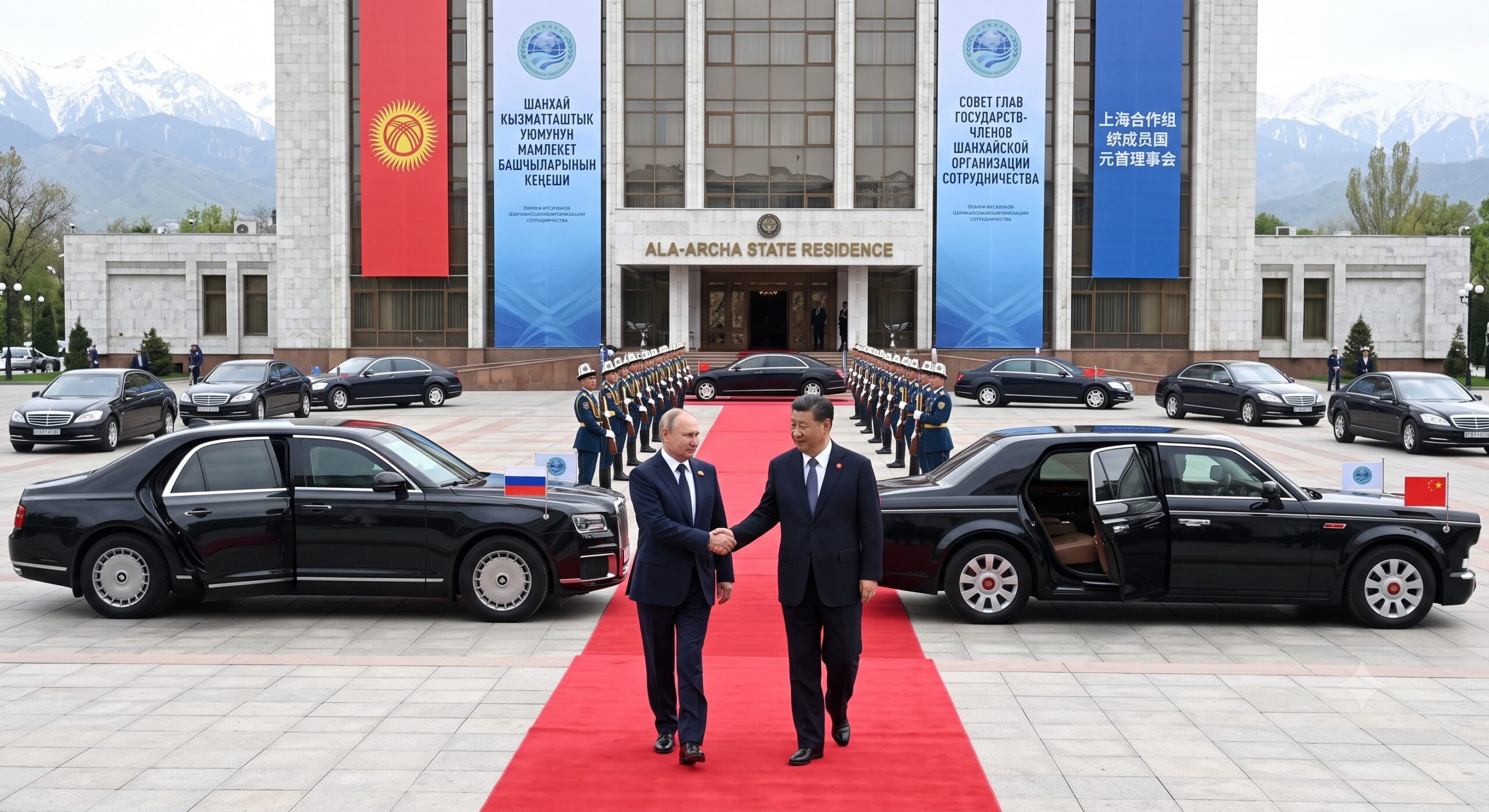
At the Shanghai Cooperation Organisation summit in Bishkek, Kyrgyzstan, Russian President Vladimir Putin and Chinese President Xi Jinping met against a stately backdrop, framed by the official state limousines that transport them across the world. Beyond high-level diplomacy, state visits like this serve as rolling exhibitions of national industrial power and automotive craftsmanship. Both leaders intentionally forego foreign luxury marques in favor of custom-built domestic flagships that project political authority and sovereign technology. Stepping onto the red carpet between their armored convoys, the two leaders highlight a calculated fusion of statecraft, supreme luxury, and tactical engineering.
President Vladimir Putin arrived in Russia’s domestically developed flagship, the Aurus Senat Limousine, designed by the state-backed NAMI institute. Introduced under the ambitious Kortezh project, the Senat was commissioned to replace foreign vehicles in the Kremlin fleet and revive Russia’s heritage of elite state vehicles. The Senat boasts a imposing, upright chrome grille with vertical slats and classic three-box limousine proportions that channel imperial Russian elegance alongside modern automotive aesthetics. Powered by a 4.4-liter twin-turbocharged V8 hybrid engine developed with Russian engineering expertise, it delivers nearly 600 horsepower to maneuver its massive armored frame with smooth acceleration. Putin strongly favors the Senat for both domestic parades and international summits, often presenting it to foreign leaders as a symbol of Russian engineering self-reliance.
Complementing its exterior presence, the Aurus Senat is engineered to function as a mobile, fortified command center capable of operating under extreme threats. The vehicle incorporates heavy ballistic steel plating, thick multilayer bulletproof glass, blast-resistant Kevlar floor shielding, and military-grade run-flat tires mounted on distinctive multi-spoke wheels. Inside, the passenger compartment is sealed with an independent oxygen supply system to guard against chemical or biological hazards, alongside encrypted communication links that keep the Russian president continuously connected to defense networks. In terms of comfort, Putin prefers a secluded, plush environment finished in premium Russian wood trim, bespoke leather, and private folding tables. The Aurus Senat is not merely personal transportation; it is a heavy-duty fortress tailored to the strict security doctrine of the Russian state.
On the other side of the red carpet stands President Xi Jinping’s official vehicle, the ultra-exclusive Hongqi N701 (and its overseas counterpart series like the N501), manufactured by China’s FAW Group. The Hongqi—meaning “Red Flag”—carries historic prestige as the historic brand of Chinese communist leadership dating back to Chairman Mao Zedong. Xi has revived and elevated this tradition, mandating that Chinese officials use domestic vehicles rather than imported German luxury sedans to champion national self-confidence. The N701 showcases a commanding rectangular front profile, an expansive chrome waterfall grille, and the signature raised red ribbon badge stretching down the center of the hood and along the front fenders. It represents the pinnacle of contemporary Chinese luxury design, blending classical imperial motifs with cutting-edge automotive elegance.
Underneath its polished black bodywork, the Hongqi limousine is equipped with high-output powertrain options—typically featuring a specialized 3.0-liter V6 hybrid or FAW’s potent 4.0-liter turbocharged V8 and V12 engines—designed to handle substantial armored weight. Xi Jinping brought his Hongqi limousine directly to Bishkek, consistent with his protocol of airlifting his official car to major summits worldwide. The vehicle rides on extra-thick, reinforced run-flat wheels and features a stretched B-pillar configuration that dramatically extends the rear cabin space. Its presence on foreign soil is an unambiguous statement of China’s rise in advanced automotive manufacturing and global prominence.
The security features of Xi Jinping’s Hongqi remain closely guarded state secrets, but the limousine is comprehensively reinforced to withstand high-caliber firearms, roadside explosives, and direct projectile strikes. Its heavily armored chassis and reinforced doors create an impenetrable cocoon, while specialized air filtration systems ensure occupant safety in contaminated environments. The cabin reflects Xi’s preference for understated, stately luxury, featuring noise-canceling acoustics, premium dark leather, refined lacquer woodwork, and integrated digital consoles that facilitate direct leadership operations on the move. Every detail within the cabin emphasizes security, privacy, and seamless control during high-stakes diplomatic itineraries.
The contrast between the Aurus Senat and the Hongqi N701 reflects the distinct national styles and shared strategic priorities of their respective leaders. Putin’s Aurus carries a bold, imposing, and muscular demeanor influenced by classic European luxury limousines, projecting strength and industrial independence in the face of international sanctions. In contrast, Xi’s Hongqi embodies a blend of modern minimalism and traditional Chinese prestige, projecting institutional authority, refined elegance, and economic sophistication. Despite their aesthetic variations, both limousines share a common design philosophy: they prioritize extreme ballistic defense, independent communication hubs, and immense size over sporty agility.
Ultimately, the image of Putin and Xi Jinping shaking hands between their respective state limousines captures an essential intersection of automotive prestige and geopolitical symbolism. In Bishkek, their convoys formed more than just secure transportation; they acted as visual declarations of their countries’ industrial capabilities and political autonomy. As both leaders continue to champion home-grown automotive technology on the world stage, the Aurus Senat and Hongqi N701 stand as rolling ambassadors of modern statecraft and armored engineering.